

Car Accident Mediation in Georgia
Estimated Read Time: 14-15 minutes.
Key Takeaways
Mediation is a Strategic Negotiation: Mediation is not simply a meeting but a powerful tool that allows you to bypass crowded courtrooms and take control of your recovery. It serves as a private setting where you can force insurance companies to face the human story of your injuries rather than treating them as just a file number.
The Good Faith Requirement: While Georgia judges often require parties to attempt mediation before a trial date is scheduled, you cannot be forced to accept an unfair settlement. The only strict rule is the good faith requirement, which mandates that both sides show up on time and make a reasonable effort to listen.
Documentation Acts as a Medical Paper Trail: A successful mediation requires a meticulous record of every medical interaction from the moment of the accident.
Venue Influences Settlement Value: In Georgia, the specific county where the case is handled often plays a significant role in the settlement price range.
Protection Through the Made Whole Doctrine: Settling through mediation often puts more money in your pocket because of the Made Whole Doctrine. This law protects you by preventing health insurance companies from taking a cut of your settlement check unless you have been fully compensated for all your losses, including pain and suffering
 Car Accidents and Mediation
A car accident can be highly stressful, even before it’s time to negotiate with an insurance provider. An insurance company’s primary goal is to protect its profits, which often means paying you as little as possible. They might try to repeatedly delay your claim in the hopes you’ll get frustrated and accept a lower offer. They might attempt to deny that their driver was at fault or claim your injuries were pre-existing from a prior incident. They might even try to defend their low offers by using aggressive legal tactics.
While a state-wide law does not require mediation for every accident, a Georgia judge will likely ask you to pursue mediation once a lawsuit is filed. If you are just talking to an insurance company and haven’t gone to court yet, mediation is a choice both sides must agree to. Many Georgia counties will even refuse to give you a trial date until you prove that you at least tried to settle through mediation first, encouraging people to solve the problem privately before using the expensive and slow trial process.
While the court can force you to go to the meeting, it cannot force you to actually sign a settlement or agree to a specific amount of money. The only strict rule is the good faith requirement. This means that you and the insurance company must show up on time and make a reasonable effort to listen to the other side’s offers. You are not allowed to just walk in and walk out immediately. However, if the insurance company offers an amount that you think is too low, your good faith duty is satisfied just by the act of hearing them out. You are allowed to say no to their offer and take your case to a jury trial. While the goal is to make sure everyone tries their best to be reasonable, you always retain the final say on whether a deal is fair for your injuries.
Benefits of Mediation
There are ways to avoid a trial and the further stress and cost that comes with it. Using a mediator helps to level the playing field by moving your case out of ambiguous territory and into a focused, one-day negotiation. A mediator acts as a neutral expert who can help convince the insurer to offer a fair settlement without the difficulties of subjecting yourself to a trial. Using their in-depth legal knowledge, they know the lay of the land without having to crown a winner. Instead, they can offer each side a reality check of how this might go at trial.
For example, they might remind the insurance company that a jury might get angry and award you significantly more money than they are offering, while also gently reminding you of the risk associated with trial, and that a jury could decide you were partly to blame for the crash. A mediator’s position as a neutral expert can help convince the insurer to offer a fair settlement without the difficulties and cost of subjecting yourself to a trial.
Georgia law recognizes the powerful benefits of mediation, and many judges actually require parties to attempt mediation before they are even allowed to schedule a trial date. Since a mediator does not take sides or decide who is right, they instead act as a diplomat whose only concern is to resolve your case. But it is essential to come with a trial-ready mindset and invest in proper preparation to secure the settlement you deserve.
If you take the mediation route, all information that could come out in the charged atmosphere of a trial stays in a confidential space. As a result, you can be completely honest with the mediator about your concerns and desire to be made whole after the accident. The mediator can use these private confidences to strategically push the other side toward a number you can both live with, without ever betraying your trust. A mediator will use their legal expertise to the advantage of both parties by translating the legal risks should you go to trial, as well as the potential reality that a guaranteed check today might be better than a check for an unknown amount a few years from now.
After a settlement is reached, the mediator also serves as the architect of the final agreement. It is their job to ensure the terms are clear, including the exact amount the insurance company will pay and when the case will be officially closed. Once you and the insurance company sign that paper, the mediator’s job is finished, and you have a legally binding contract. They don’t force anyone to do anything, but they use their years of experience to guide both sides out of a stalemate and toward a finished case.
Imagine mediation as a structured discussion aimed at peaceful resolution, allowing you to settle your car accident claim without the stress, expense, and delay of a full-blown jury trial. Unlike a courtroom, where a judge or jury makes the final decision, mediation is a voluntary process where a neutral third party helps both sides reach a compromise.
Mediation improves the legal handling of your case by giving you increased control over the outcome. In a trial, a jury could give you $0 or $1,000,000.00, and you have no way to predict which it will be. In mediation, you only sign a settlement if you agree that the amount is fair. It is also important to remember that since mediation is entirely confidential, nothing said during the negotiation can later be used against you in court if you don’t reach a deal.
Statute of Limitations
Think of the statute of limitations as a countdown clock that sets the deadline for filing a lawsuit. If you don’t file your case in court before this clock runs out, you lose your legal right to sue, no matter how badly you were hurt. The deadline for most personal injury claims in Georgia is two years from the date of the accident. However, the different parts of a claim actually have different deadlines. While you only have two years to sue for your physical injuries, you have four years to sue for property damage.
It is essential to know that the countdown clock can sometimes be paused or tolled due to exceptional circumstances. For example, if the person injured is a child, the two-year clock will not start until they turn 18. A pause might also happen if there is a pending criminal case or traffic ticket related to the accident. Until the matter is resolved, the clock won’t always restart, giving you additional time to file. The rules are much stricter if you are suing a government entity, such as an accident involving a city bus or a vehicle owned and operated by the state. In this case, you will only have six months to a year to give notice of your claim. These deadlines are firm, and it is best to start the process as soon as possible to avoid missing the window altogether.
Tolling Agreement
A tolling agreement is another type of pause button for the legal clock. It is a private contract in which the person who caused the accident, along with their insurance company, agrees to temporarily suspend the two-year deadline for you to file a lawsuit. This is usually done so that both sides can continue talking and trying to settle the case without the pressure of a looming court date. By signing this agreement, the defendant promises that they won’t try to get your case thrown out for being late as long as you file within the new, extended timeframe that was mutually agreed upon.
Tolling agreements are incredibly useful in complex cases. For example, if you are still receiving medical treatment and don’t yet know what your total bills will be, instead of rushing to file a lawsuit just to beat the two-year deadline, your lawyer can ask for a tolling agreement to pause the clock. This keeps the doors for negotiation open and saves everyone the costs of going to court. However, it is important to remember that these are voluntary contracts. An insurance company does not have to sign one, and if they refuse, you still must file your lawsuit before the original statute of limitations expires to protect your rights.
 Fault-Based System
Georgia uses a fault-based system, which is essentially a “you break it, you buy it” rule for car accidents. This means that the driver who caused the crash is usually responsible for paying for your injuries and any damage to your vehicle. Unlike some states where your own insurance company pays your bills regardless of what happened, Georgia requires you to prove that the other driver did something wrong, such as speeding or running a red light, before their insurance company has to pay you anything. This process is based on the idea that if someone breaches a legal duty, such as the duty to drive safely, they are liable for the resulting harm.
Georgia law has a built-in layer of fairness called modified comparative negligence, which acknowledges that sometimes both drivers are a little to blame. This means that you can still collect money even if you were partially at fault, as long as you were less than 50% responsible for the accident. Imagine a court determines that you were 10% at fault because you were driving over the speed limit, but the other driver was 90% at fault for turning in front of you. This would mean that your total payout would be reduced by 10%. It is important to remember the 50% bar, because if you are found to be more than 50% at fault, you are likely to be prevented from recovering any money from the other driver.
Because of this system, a large part of negotiating in a personal injury case is usually over who was more at fault. Insurance companies will often try to shift the blame onto you to avoid paying, which is why gathering evidence, such as police reports and witness statements, is so vital. You will need this information to advocate for yourself.
If the other driver violated a specific traffic law, a doctrine called negligence per se will apply. This essentially means that the other driver is usually considered at fault because they violated a safety statute. The goal of this system is to help ensure that the injured party is made whole again through the responsible party’s payment of medical bills, lost wages, pain, and inconvenience.
Duty of Care
Every time you get behind the wheel of a car, you make a legal promise to drive safely. This is your duty of care. It is officially known as ordinary diligence, meaning you are required to act as a reasonable, cautious, and logical person in the same situation. This doesn’t mean you have to be perfect, but it does mean that you have to make every effort to follow the rules of the road to keep others safe. This means it is your duty to pay attention to your surroundings, stay off your phone, and follow traffic laws. Every person owes this duty not just to the car directly in front of them, but to everyone on the road, including pedestrians and cyclists.
If you fail to use this ordinary care and someone gets hurt, you have breached your duty and can be held financially responsible for the damage. The law also recognizes that the level of care you need can change depending on the situation. For example, a reasonably prudent person would drive much more cautiously during a heavy summer rainstorm than on a clear, sunny day. Additionally, if a driver breaks a specific safety law, the court often considers that an automatic breach of duty. Think of your duty of care as the foundation of your case. This attitude helps to establish that the other driver had a legal responsibility to protect you from harm the moment they started their engine.
Breach of Duty
When it comes to a breach of duty, it is just a legal way of saying the other driver stopped acting with ordinary care. This means that they were more careless than a normal, safe person would have been in that same situation. A breach can work in two ways. It can be an act of commission, such as choosing to speed or text, or an act of omission, like forgetting to check a blind spot before changing lanes. To negotiate the best settlement, you have to prove that the driver’s actions fell below this safe standard.
The easiest way to do this is by showing they broke a specific traffic law, such as running a red light. The burden of proof will be on you to provide. It will be essential to gather evidence such as police citations and witness accounts. You don’t have to paint the driver out to be a villain, you simply have to show it is more likely than not that they were being careless in the moment. If you can show they were even slightly more negligent than a reasonably cautious driver should be, you should be successful in proving the breach.
This information will be crucial when negotiating with your insurance company. Their goal will be to find a way to prove that you also breached a duty to avoid paying a larger settlement. The more information you have, the better off you will be.
Modified Comparative Negligence Rule (The 50% Rule)
Georgia uses a specific system to determine how much money you can recover based on your level of fault in the accident. You might be allowed to recover money even if you are found to be partially at fault in the accident, but your percentage of the blame will reduce your payout. For example, if your case is determined to be worth $100,000.00 but you are found to be 20% at fault because you were going slightly over the speed limit, you would receive $80,000.00
This rule has limits. This cutoff is known as the 50% rule. If you are found to be 50% or more responsible for the accident, you are legally barred from recovering anything at all. Think of this like a tie where both drivers are equally to blame, and you walk away with zero. This is why insurance companies work so hard to push your fault percentage to that 50% mark.
Part of the concern with going to trial is the role of recent changes to the Georgia Tort Reform Act of 2025. Juries are now responsible for determining fault among all possible parties, including those not present in the courtroom. These additional variables can alter the outcome of the settlement. For example, a defendant can argue that a phantom vehicle or a separate person who isn’t being sued was actually the one responsible. Additionally, the 2025 law now allows a lack of evidence of seatbelt use to be used to argue that you were partially negligent in causing your own injuries, which can further reduce your payout. This system ensures that you are only paid for the portion of the accident that was someone else’s fault, provided you weren’t the primary person responsible.
To defend yourself against claims that you were more than 50% at fault, it is vital to keep a record that covers all aspects of the accident. This can include police reports and the citations received by the other driver, dashcam or surveillance video, as well as detailed witness statements that can confirm your side of the story and show that there was no way for you to avoid the consequences of the crash.
Made Whole Doctrine
The Made Whole Doctrine is a powerful consumer protection law in Georgia that acts like a shield for your settlement money. It prevents a health insurance company from taking money out of your recovery before you are truly back on your feet. An insurance company is legally barred from asking you to pay them back for medical bills that they have covered unless they can prove that you have been compensated for the full extent of the loss you suffered. This doesn’t just mean money to cover your hospital bills and any lost wages, but also the full human toll on your life. Due to the difficulty of assigning a dollar amount to emotional distress, physical pain, and life-changing events, it will be tough for an insurance company to prove that you were made whole. While not a guarantee, the Made Whole Doctrine often allows you to keep the full amount of your settlement.
The law is designed with the injured person as the priority, with the insurance company last in line. Even in the rare instance where an insurer does illustrate that you were made whole, the law will still require them to reduce their claim to help cover your attorney’s fees and other legal costs.
However, this is not a perfect system. This Georgia protection usually does not apply if you have a Self-Funded ERISA plan through a large employer. Because those specific plans are governed by federal law rather than Georgia law, they can sometimes ignore the Made Whole Doctrine and demand their money back even if you aren’t fully compensated. It is important to know your rights and protections within the law as they apply to the Made Whole Doctrine, as they will play a vital role in your settlement.
FAQs
Is mediation required by law in Georgia? While there is no statewide law requiring mediation in every accident, local judges frequently mandate mediation after a lawsuit is filed.
Can I be forced to settle my case during mediation? No. While a court can force you to attend the meeting, it cannot force you to sign a settlement or agree to a specific dollar amount.
What is the Good Faith requirement? This is the only strict rule for mediation. Both you and the insurance company must show up on time and make a reasonable effort to listen to each side’s offers. Your duty is satisfied once you have heard them out.
Will the information I share be used against me later? No. Mediation is a confidential process. Information discussed in the meeting remains in a private space and cannot be used against you in court if a deal is not reached.
How does my own fault affect the mediation settlement? Georgia follows a 50% rule for modified comparative negligence. You can recover money as long as you are less than 50% responsible for the accident, but your percentage of blame will reduce your final settlement amount.
Economic Damages
Economic Damages are the part of your claim that covers the specific dollar amount the accident cost you. These can typically be proven by collecting the receipts, bills, and pay stubs that you accumulated after your accident. It is critical to your settlement that you keep a record of these costs. According to Georgia law, you have the right to be reimbursed for all reasonable and necessary medical expenses, including the initial ambulance ride and hospital stay, as well as future needs such as physical therapy or medications.
Economic damages extend beyond medical bills. They also cover the money you lost because you couldn’t go to work, including missed paychecks, sick days you were forced to use, and even the loss of your earning capacity if your injuries prevent you from making the same amount of money in the future. You can also claim smaller out-of-pocket costs, such as the gas money spent driving to doctor appointments or the cost of hiring someone to help with housework while you were recovering.
Economic damages also cover your property, including the cost to fix your car and the diminished value of your vehicle following the damages sustained in the accident. The goal of these damages is to make sure that, at least financially, you are put back in the same position you were in before the crash happened.
 Medical Damages
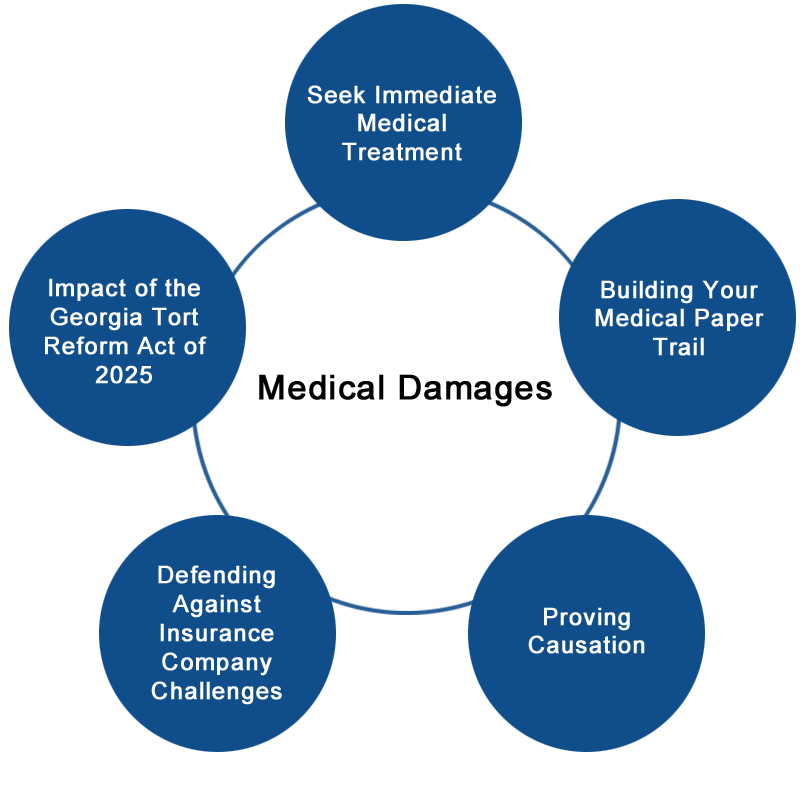
Seeing a doctor immediately after your car accident is the most critical step you can take to protect both your physical health and your legal rights in Georgia. When you go to the doctor right away, you create an official trail that links the crash directly to your injuries. The adrenaline caused by your accident can mask serious issues like whiplash, internal bleeding, or concussions for hours or even days, and an early diagnosis ensures that hidden injuries are documented before they get worse. If you delay treatment, an insurance company might also attempt to argue that you allowed your own injuries to get worse by failing to act responsibly. To be safe, ensure your health and credibility by seeing a doctor as soon as you can.
It will be critical when negotiating with the insurance company that you have kept a detailed record of all your medical visits and the bills you incurred for proper treatment. The burden of proof is on you to prove that your injuries were sustained during the accident and not elsewhere, and medical records will serve as the primary evidence that the other driver’s negligence is what caused you harm. If you wait even a few days to seek care, insurance companies will almost always use a gap in treatment to argue that you weren’t truly hurt or that your pain was caused by a different event that happened after the wreck.
Causation is the legal bridge that connects the other driver’s role in the accident directly to your injuries. It isn’t enough to show that the other driver was being careless, you must also prove that you were hurt because of the accident. This can be done in two ways. First, you can show a common-sense link, which draws a tie between the driver’s actions and whether the accident would have been caused without them. The second focuses on fairness, asking whether your injury was a foreseeable result of the crash or an unrelated event. The law will not hold someone responsible for your injuries if these connections can’t be proven.
Because you have the burden of proof, the insurance company will often try to break this bridge by arguing that something else caused your pain. They might claim your injuries are actually from an old sports injury, a separate health issue, or even a gap in treatment if you didn’t see a doctor immediately after the crash. To fight this, you need a clear paper trail of medical records and sometimes expert testimony to show that the physics of the collision match the damage to your body. Essentially, causation is how you prove that the crash didn’t just happen, but that it is the direct connection and reason for your suffering today.
Recent changes to the law have made this timeline all the more critical. The Georgia Tort Reform Act of 2025 mandates that juries are now allowed to see both the cost of your medical bill as well as the actual amount your insurance company paid. This makes your initial visit to the doctor vital in the face of an insurance company claiming that your treatment was overblown or unnecessary.
The Medical Paper Trail
It will be essential for you to gather a collection of every document created by a doctor or hospital from the moment of your accident until the day of your mediation. Think of these documents as a silent witness that proves your side of the story to be true. Recent changes to the law have made it an absolute necessity to be as detailed as possible in your record-keeping. Insurance companies are now allowed to show a jury the exact amount that was actually paid for your care, instead of just the higher price paid by your insurance. This means that, to be thorough, you should also include an explanation of the benefits of your health insurance to show the actual cost of your treatment.
The trail will begin with your first trip to the emergency room, urgent care, or your physician immediately after the accident. This is important when proving causation, as it shows the immediate impact of your injuries. Your record keeping will continue with any physician notes or diagnostic reports, such as an MRI or X-Ray, that objectively document your injury. As your treatment continues, keep all reports from your physical therapist, physician, and therapist. Even your pharmacy receipts should be kept to present the most accurate picture of how your injury affected your life. Without this complete, day-by-day history, the insurance company will be able to argue that your pain is unsubstantiated. A well- organized paper trail of your treatment makes it very difficult for them to deny you a fair settlement. To ensure a smooth mediation, your paper trail must be organized but also authenticated. This may require a signed affidavit from your medical provider confirming that the records are accurate.
Additional items, such as keeping a daily injury journal that tracks your pain, mobility limitations, and details how your injury can also be helpful. Taking photographs of your visible injuries, such as bruising, surgical scars, and swelling, can add a helpful visual component as you heal. While it might seem like overkill, these extra steps will help you to put your best foot forward.
Collateral Source Rule
The Collateral Source Rule is a long-standing legal protection that ensures that the driver responsible for the accident cannot get a discount on what they owe you just because you were responsible enough to have your own insurance.
Under the standard version of this rule, if you were hit by a car and had received $50,000.00 in medical bills, the insurance company for the other driver was not allowed to tell the jury that your own health insurance already paid those bills. The person responsible would still be on the hook for the full cost of the damage they caused, instead of benefiting from your health insurance coverage. Recent changes to this law in April 2025 and January 2026 have slightly altered this.
Changes to the Law
Recent changes to the law have shifted how certain information about your accident can appear at trial, which can subsequently affect your insurance. Senate Bills 68 and 69 were enacted as a two-part system to overhaul car accident lawsuits in Georgia. Senate Bill 68, which went into effect on April 21, 2025, is known as the Georgia Tort Reform Act of 2025.
Its main goal is to reduce high jury verdicts by requiring greater transparency into your medical bills. Under this law, juries are no longer just shown the price originally billed by a hospital, but they are allowed to see what you actually paid for your care. This can often significantly reduce the starting point for settlement negotiations. One of the most important aspects of this bill is that juries are now allowed to hear if you weren’t wearing your seatbelt. Furthermore, it allows for bifurcated trials, which means the jury must first decide who is at fault for the crash before they are even allowed to hear about how much you have suffered or how badly you were hurt.
Senate Bill 69, on the other hand, serves as a consumer protection law that regulates the money and insurance rules behind the scenes, with many of its rules taking effect for lawsuits filed in 2026. While SB 68 allows the seatbelt defense to be used against you in court, SB 69 provides a shield by banning insurance companies from raising your rates or canceling your policy just because you weren’t wearing a seatbelt.
These changes also place strict rules on lawsuit loans, such as money you might borrow to pay rent while waiting for a settlement, by requiring these lending companies to stay out of your legal strategy and register with the state. For cases moving forward in 2026, your lawyer will be required to tell the insurance company exactly who you borrowed money from and how much, which gives the insurer more information during the discovery phase of your case.
Together, these laws make it much more difficult to get higher settlements, but they also provide new protections for your insurance status and more oversight on legal lenders. If you are in mediation today, the insurance company is likely using the rules from SB 68 to offer you less money based on your actual medical costs and potential seatbelt use. However, if your case moves to a formal lawsuit in 2026, you will then gain the extra protections of SB 69, which ensures that while your payout might be smaller, your own car insurance won’t become more expensive because of the evidence used in court. Ultimately, these laws require you to be better prepared and organized with your medical records to prove your case is still worth a fair recovery.
The Human Cost
Depending on the severity of your accident, the emotional trauma, physical pain, and changes to your everyday life can contribute to a more substantial human toll. There is no fixed mathematical formula to determine what changes, such as constant backache or no longer being able to play catch with your child, truly cost. The enlightened conscience of impartial jurors determines this. This legal standard means a group of your fellow citizens will listen to your story and use their own sense of fairness to try to devise a dollar amount they believe to be just.
There is typically no cap on these damages in Georgia. The jury has the power to award a number they believe reflects your suffering and addresses how much the accident has changed your daily life and peace of mind. Even if you do not go to trial and remain in mediation, the same concept will still apply. There is no fixed price tag for emotional distress, pain, and suffering. When you are in mediation, you don’t have 12 jurors in the room, but the team in the room will still be trying to estimate what those 12 imaginary people would try to do if they heard your story in a courtroom.
This is another reason why documenting your experience will be so important. By presenting evidence of the toll on your quality of life, a mediator will be able to address the insurance company with an estimate about what a jury’s determination might have been in your county. In a similar way to medical damages, keeping a record that includes journal entries, photos, and medical documents that detail changes to your daily life can make all the difference in presenting an objective view of your life after the accident. Even an employer letter can be used as a persuasive tool if you lost out on wages or even potentially missed a promotion, or the inability to perform specific job duties due to the negligence of the other person. This pressures the insurance company into a fairer settlement, because if they go to court, it might lead to an even bigger verdict down the road, even though there is no guarantee of that happening for either party.
Punitive Damages
While mediation cannot award punitive damages the way a jury can, the threat of a later jury awarding punitive damages is a powerful lever to push the insurance company into a much higher settlement. It is not the mediator’s responsibility to punish the driver. Still, by illustrating to an insurance company that their driver’s actions were so reckless, you are also showing that, were the case to go to trial, it would likely result in a far more expensive verdict. Highlighting the aggravating factors can emphasize just why an insurance company would rather avoid your case when it goes to trial.
Think of punitive damages as a special kind of legal penalty that has nothing to do with paying back your medical bills or lost wages. Instead, their only purpose is to punish a driver for dangerous or reckless behavior. These types of damages are not awarded for a typical mistake, such as a fender-bender, but rather for behavior that involves conscious awareness of the risk and indifference to who might have been injured as a result.
There is a strict cap of $250,000.00 on these damages in Georgia. However, this cap can be removed in specific high-danger situations, such as when the driver was under the influence of alcohol or drugs, or if they intentionally tried to cause harm during a road rage incident. This is determined in two stages. First, it will be determined whether you are owed money for your injuries, and then whether the at-fault driver acted in a way that warrants punishment.
The Location of Your Accident
The location of your accident might play a more critical role than you think in dictating your settlement and can even be used as a powerful negotiation tool. This is called the Venue Factor. This refers to the specific county where your accident happened or where the person who hit you lives.
Different counties within Georgia have very different reputations for how much money they award for pain and suffering. If your case is filed in a plaintiff-friendly county, the insurance company is often more fearful of going to trial. Jurors in larger cities tend to be more sympathetic and award higher amounts, so insurance companies are likely to pay you more money through mediation to avoid the risk of these courtrooms.
During mediation, everyone in the room uses the venue factor to figure out the market value of your claim. The mediator will look at recent jury verdicts in that county to show the insurance company what people in that area think an injury like yours is worth. This also has a flip side. If the accident happened in a more rural county, the insurance company might offer less if local juries are known to be more frugal with their awards. The location of your case can often be a major contributor to setting the price range for your settlement, and can be used as leverage to push the insurance company to their highest possible offer.
Net Recovery
When it comes down to it, net recovery is the most important number at the end of your case. This is the actual amount you will receive after all other hands have been removed from the cookie jar. Over the course of your mediation, you might hear a large gross settlement amount, such as $100,000.00, but that is not the amount you will actually keep.
Your net recovery is calculated by taking that considerable number and subtracting three main things: your attorney’s fees, the out-of-pocket costs your lawyer spent to build the case (such as filing fees or expert witness costs), and any medical liens.
The changes to the law that affect the payout based on your actual medical fees are essential here. While your net recovery will be based on the exact amount paid to health care providers rather than the original cost set by the hospital, this might help you down the line by reducing any medical liens. While it might reduce the gross settlement, the Made Whole Doctrine will act as a protection of your net recovery. If your settlement isn’t enough to cover all your losses, your health insurance company will be barred from taking any money from you to pay them back for your care.
Costs of Mediation
The cost of a mediator usually ranges from $250.00 to $500.00 per hour, and will typically be split equally between you and the insurance company. In a car accident case, you won’t usually have to pay your half out of pocket on the same day of the meeting. Instead, your lawyer will typically advance the cost as a case expense, which you will pay back once you have received your final settlement check. If the mediation is successful, your lawyer might also negotiate a settlement where the insurance company agrees to pay the mediator’s entire bill as part of the deal, ensuring that none of that cost comes out of your take-home pay.
The costs and process might vary from situation to situation. For example, if your case is in the Magistrate Court, many Georgia counties offer mediators at no cost or for a minimal one-time filing fee. On the other hand, in a high-stakes Superior Court case involving a complex wreck, the mediator might be a specialized expert who charges a premium. Regardless of the cost, your lawyer’s goal is to make sure the investment in mediation is worth it. By paying for a few hours of a mediator’s time, you are often avoiding the much higher costs of a trial, which ultimately helps protect your net recovery.
 Receiving Your Settlement
Think of your settlement as a final, legally binding agreement that acts as a peace treaty between you and the insurance company. Instead of a judge or jury deciding your fate, you and the insurer sign a Settlement Memorandum at the end of the mediation. This document locks in a specific dollar amount that the insurance company must pay you. In exchange, you agree to drop your lawsuit and never ask for more money for this specific accident again.
Everything discussed during the meeting is confidential, but the final signed agreement is a power contract that a court can enforce if the insurance company attempts to back out.
Once the agreement is signed, the process usually takes about four to six weeks to wrap up. You will be asked to sign a General Release, which is a formal document that officially clears the other driver of all liability. Following this, your lawyer will file a Dismissal with Prejudice, which tells the court the case is closed forever. Before you get your final check, your lawyer is legally required to resolve any medical liens to hospitals or your insurance company. But don’t forget, due to the Made Whole Doctrine, you are likely to be in a good position to keep more of the settlement money if the settlement itself wasn’t large enough to cover your losses adequately.
Schedule a Case Evaluation
Choosing mediation means taking a stand against insurance companies that try to treat your injury like a math problem rather than a life-altering moment with long-term effects. Instead of being just another file at a high-volume law firm, mediation allows you to fight for a fast, maximum settlement that is decided with consideration and care. This is your opportunity to take control of your future immediately, rather than waiting years for a trial that might never happen.
Mediation is also your chance to leverage a mediator’s experience to negotiate a settlement that actually makes you whole again. It is a strategic move that shows the insurance company you are prepared, organized, and ready to go to court if they don’t offer a fair amount. Ultimately, mediation is a call to be better prepared than the opposition, to act with timing and precision, and to relentlessly pursue the justice that the law allows you to claim.
Areas Serviced:
Abbeville, GA
Acworth, GA
Adairsville, GA
Adel, GA
Adrian, GA
Ailey, GA
Alamo, GA
Alapaha, GA
Albany, GA
Aldora, GA
Allenhurst, GA
Allentown, GA
Alma, GA
Alpharetta, GA
Alston, GA
Alto, GA
Ambrose, GA
Americus, GA
Andersonville, GA
Arabi, GA
Aragon, GA
Arcade, GA
Argyle, GA
Arlington, GA
Arnoldsville, GA
Ashburn, GA
Athens, GA
Atlanta, GA
Attapulgus, GA
Auburn, GA
Augusta, GA
Austell, GA
Avalon, GA
Avera, GA
Avondale Estates, GA
Baconton, GA
Bainbridge, GA
Baldwin, GA
Ball Ground, GA
Barnesville, GA
Bartow, GA
Barwick, GA
Baxley, GA
Bellville, GA
Berkeley Lake, GA
Berlin, GA
Bethlehem, GA
Between, GA
Bishop, GA
Blackshear, GA
Blairsville, GA
Blakely, GA
Bloomingdale, GA
Blue Ridge, GA
Bluffton, GA
Blythe, GA
Bogart, GA
Boston, GA
Bostwick, GA
Bowdon, GA
Bowersville, GA
Bowman, GA
Braselton, GA
Braswell, GA
Bremen, GA
Brinson, GA
Bronwood, GA
Brookhaven, GA
Brooklet, GA
Brooks, GA
Broxton, GA
Brunswick, GA
Buchanan, GA
Buckhead, GA
Buena Vista, GA
Buford, GA
Butler, GA
Byromville, GA
Byron, GA
Cadwell, GA
Cairo, GA
Calhoun, GA
Camak, GA
Camilla, GA
Canon, GA
Canton, GA
Carl, GA
Carlton, GA
Carnesville, GA
Carrollton, GA
Cartersville, GA
Cave Spring, GA
Cecil, GA
Cedartown, GA
Centerville, GA
Centralhatchee, GA
Chamblee, GA
Chatsworth, GA
Chattahoochee Hills, GA
Chauncey, GA
Chester, GA
Chickamauga, GA
Clarkesville, GA
Clarkston, GA
Claxton, GA
Clayton, GA
Clermont, GA
Cleveland, GA
Climax, GA
Cobbtown, GA
Cochran, GA
Cohutta, GA
Colbert, GA
College Park, GA
Collins, GA
Colquitt, GA
Columbus, GA
Comer, GA
Commerce, GA
Concord, GA
Conyers, GA
Coolidge, GA
Cordele, GA
Cornelia, GA
Covington, GA
Crawford, GA
Crawfordville, GA
Culloden, GA
Cumming, GA
Cusseta, GA
Cuthbert, GA
Dacula, GA
Dahlonega, GA
Daisy, GA
Dallas, GA
Dalton, GA
Damascus, GA
Danielsville, GA
Danville, GA
Darien, GA
Dasher, GA
Davisboro, GA
Dawson, GA
Dawsonville, GA
Dearing, GA
Decatur, GA
Deepstep, GA
Demorest, GA
Denton, GA
De Soto, GA
Dexter, GA
Dillard, GA
Doerun, GA
Donalsonville, GA
Dooling, GA
Doraville, GA
Douglas, GA
Douglasville, GA
Dublin, GA
Dudley, GA
Duluth, GA
Dunwoody, GA
Du Pont, GA
East Dublin, GA
East Ellijay, GA
Eastman, GA
East Point, GA
Eatonton, GA
Echols County, GA
Edge Hill, GA
Edison, GA
Elberton, GA
Ellaville, GA
Ellenton, GA
Ellijay, GA
Emerson, GA
Enigma, GA
Ephesus, GA
Eton, GA
Euharlee, GA
Fairburn, GA
Fairmount, GA
Fargo, GA
Fayetteville, GA
Fitzgerald, GA
Flemington, GA
Flovilla, GA
Flowery Branch, GA
Folkston, GA
Forest Park, GA
Forsyth, GA
Fort Gaines, GA
Fort Oglethorpe, GA
Fort Valley, GA
Franklin, GA
Franklin Springs, GA
Funston, GA
Gainesville, GA
Garden City, GA
Garfield, GA
Gay, GA
Geneva, GA
Georgetown, GA
Gibson, GA
Gillsville, GA
Girard, GA
Glennville, GA
Glenwood, GA
Good Hope, GA
Gordon, GA
Graham, GA
Grantville, GA
Gray, GA
Grayson, GA
Greensboro, GA
Greenville, GA
Griffin, GA
Grovetown, GA
Gumbranch, GA
Guyton, GA
Hagan, GA
Hahira, GA
Hamilton, GA
Hampton, GA
Hapeville, GA
Haralson, GA
Harlem, GA
Harrison, GA
Hartwell, GA
Hawkinsville, GA
Hazlehurst, GA
Helen, GA
Hephzibah, GA
Hiawassee, GA
Higgston, GA
Hiltonia, GA
Hinesville, GA
Hiram, GA
Hoboken, GA
Hogansville, GA
Holly Springs, GA
Homeland, GA
Homer, GA
Homerville, GA
Hoschton, GA
Hull, GA
Ideal, GA
Ila, GA
Iron City, GA
Irwinton, GA
Ivey, GA
Jackson, GA
Jacksonville, GA
Jakin, GA
Jasper, GA
Jefferson, GA
Jeffersonville, GA
Jenkinsburg, GA
Jersey, GA
Jesup, GA
Johns Creek, GA
Jonesboro, GA
Junction City, GA
Kennesaw, GA
Keysville, GA
Kingsland, GA
Kingston, GA
Kite, GA
LaFayette, GA
LaGrange, GA
Lake City, GA
Lakeland, GA
Lake Park, GA
Lavonia, GA
Lawrenceville, GA
Leary, GA
Leesburg, GA
Lenox, GA
Leslie, GA
Lexington, GA
Lilburn, GA
Lilly, GA
Lincolnton, GA
Lithonia, GA
Locust Grove, GA
Loganville, GA
Lone Oak, GA
Lookout Mountain, GA
Louisville, GA
Lovejoy, GA
Ludowici, GA
Lula, GA
Lumber City, GA
Lumpkin, GA
Luthersville, GA
Lyerly, GA
Lyons, GA
McCaysville, GA
McDonough, GA
McIntyre, GA
Macon, GA
McRae–Helena, GA
Madison, GA
Manassas, GA
Manchester, GA
Mansfield, GA
Marietta, GA
Marshallville, GA
Martin, GA
Maxeys, GA
Maysville, GA
Meansville, GA
Meigs, GA
Menlo, GA
Metter, GA
Midville, GA
Midway, GA
Milan, GA
Milledgeville, GA
Millen, GA
Milner, GA
Milton, GA
Mitchell, GA
Molena, GA
Monroe, GA
Montezuma, GA
Monticello, GA
Montrose, GA
Moreland, GA
Morgan, GA
Morganton, GA
Morrow, GA
Morven, GA
Moultrie, GA
Mountain City, GA
Mountain Park, GA
Mount Airy, GA
Mount Vernon, GA
Mount Zion, GA
Nahunta, GA
Nashville, GA
Nelson, GA
Newborn, GA
Newington, GA
Newnan, GA
Newton, GA
Nicholls, GA
Nicholson, GA
Norcross, GA
Norman Park, GA
North High Shoals, GA
Norwood, GA
Nunez, GA
Oak Park, GA
Oakwood, GA
Ochlocknee, GA
Ocilla, GA
Oconee, GA
Odum, GA
Offerman, GA
Oglethorpe, GA
Oliver, GA
Omega, GA
Orchard Hill, GA
Oxford, GA
Palmetto, GA
Parrott, GA
Patterson, GA
Pavo, GA
Peachtree City, GA
Peachtree Corners, GA
Pearson, GA
Pelham, GA
Pembroke, GA
Pendergrass, GA
Perry, GA
Pinehurst, GA
Pine Lake, GA
Pine Mountain, GA
Pineview, GA
Pitts, GA
Plains, GA
Plainville, GA
Pooler, GA
Portal, GA
Porterdale, GA
Port Wentworth, GA
Poulan, GA
Powder Springs, GA
Pulaski, GA
Quitman, GA
Ranger, GA
Ray City, GA
Rayle, GA
Rebecca, GA
Register, GA
Reidsville, GA
Remerton, GA
Rentz, GA
Resaca, GA
Rest Haven, GA
Reynolds, GA
Rhine, GA
Riceboro, GA
Richland, GA
Richmond Hill, GA
Riddleville, GA
Rincon, GA
Ringgold, GA
Riverdale, GA
Roberta, GA
Rochelle, GA
Rockmart, GA
Rocky Ford, GA
Rome, GA
Roopville, GA
Rossville, GA
Roswell, GA
Royston, GA
Rutledge, GA
St. Marys, GA
Sale City, GA
Sandersville, GA
Sandy Springs, GA
Santa Claus, GA
Sardis, GA
Sasser, GA
Savannah, GA
Scotland, GA
Screven, GA
Senoia, GA
Shady Dale, GA
Sharon, GA
Sharpsburg, GA
Shellman, GA
Shiloh, GA
Siloam, GA
Sky Valley, GA
Smithville, GA
Smyrna, GA
Snellville, GA
Social Circle, GA
Soperton, GA
South Fulton, GA
Sparks, GA
Sparta, GA
Springfield, GA
Stapleton, GA
Statesboro, GA
Statham, GA
Stillmore, GA
Stockbridge, GA
Stone Mountain, GA
Stonecrest, GA
Sugar Hill, GA
Summertown, GA
Summerville, GA
Sumner, GA
Sunny Side, GA
Surrency, GA
Suwanee, GA
Swainsboro, GA
Sycamore, GA
Sylvania, GA
Sylvester, GA
Talbotton, GA
Talking Rock, GA
Tallapoosa, GA
Tallulah Falls, GA
Talmo, GA
Tarrytown, GA
Taylorsville, GA
Temple, GA
Tennille, GA
Thomaston, GA
Thomasville, GA
Thomson, GA
Thunderbolt, GA
Tifton, GA
Tiger, GA
Tignall, GA
Toccoa, GA
Toomsboro, GA
Trenton, GA
Trion, GA
Tucker, GA
Tunnel Hill, GA
Turin, GA
Twin City, GA
Tybee Island, GA
Tyrone, GA
Ty Ty, GA
Unadilla, GA
Union City, GA
Union Point, GA
Uvalda, GA
Valdosta, GA
Varnell, GA
Vernonburg, GA
Vidette, GA
Vienna, GA
Vidalia, GA
Villa Rica, GA
Waco, GA
Wadley, GA
Waleska, GA
Walnut Grove, GA
Walthourville, GA
Warm Springs, GA
Warner Robins, GA
Warrenton, GA
Warwick, GA
Washington, GA
Watkinsville, GA
Waverly Hall, GA
Waycross, GA
Waynesboro, GA
Webster County, GA
West Point, GA
Whigham, GA
White, GA
White Plains, GA
Whitesburg, GA
Willacoochee, GA
Williamson, GA
Winder, GA
Winterville, GA
Woodbine, GA
Woodbury, GA
Woodland, GA
Woodstock, GA
Woodville, GA
Woolsey, GA
Wrens, GA
Wrightsville, GA
Yatesville, GA
Young Harris, GA
Zebulon, GA
Call (912) 351-8775 or Schedule a Free Case Evaluation Online